50 Great Women Writers — how many have you heard of?
February 4, 2013 at 10:35 pm | Posted in Uncategorized | 10 CommentsTags: books, literary canon, Robert McCrum, Women, women writers
Dear Guardian newspaper,
We note that your books editor, Robert McCrum, has published a ‘partisan list’ of 50 turning points in literature, and that comments have remarked on the low numbers of women (7).
To begin redressing the gender balance, here is another list – even more partisan, in that it consists entirely of influential women writers. (McCrum’s original choices are in red.)
Here are those 50 great, pioneering women.
Yours,
Kathleen Taylor (science writer) & Gillian Wright (senior lecturer in English literature)
1.Julian of Norwich: Sixteen Revelations of Divine Love (c. 1393; thought to be the first book written in English by a woman)
2.Christine de Pizan: The Book of the City of Ladies (1405; this courtly French poet wrote about women’s roles and emphasized their positive contributions to society)
3.Margery Kempe: The Book of Margery Kempe (1436; women can do autobiography)
4.Mary Sidney: Psalms (c. 1599; her paraphrases of the Psalms were as good as or better than her brother Philip’s)
5.Margaret Cavendish: The Blazing World (1666; women can do science-fiction, long before that term was invented)
6.Lucy Hutchinson: The Life of Colonel Hutchinson (c. 1673; women can do biography)
7.Anne Bradstreet: Severall Poems (1678; Bradstreet is often called ‘the first American poet’)
8.Aphra Behn: Orinooko (1688; pioneering playwright and poet who showed that women can make a living from writing)
9.Mary Astell: A Serious Proposal to the Ladies (1694; Astell advocated a university for women)
10.Anne Finch: The Spleen (1701; a pioneer woman writer on mental illness)
11.Charlotte Lennox: The Female Quixote (1752; women can do satire)
12.Elizabeth Carter: All the Works of Epictetus (1758; women can translate the classics)
13.Mary Wortley-Montagu: The Turkish Embassy Letters (c. 1761; women can do travel writing)
14.Catherine Macaulay: The History of England (1763-1783; women can do history)
15.Mary Wollstonecraft: A Vindication of the Rights of Women (1792)
16.Ann Radcliffe: The Mysteries of Udolpho (1794; women can do Gothic fiction)
17.Maria Edgeworth: Castle Rackrent (1800; invents the regional novel in English)
18.Jane Austen: Pride and Prejudice (1813)
19.Mary Shelley: Frankenstein (1818; women can do enduring horror stories)
20.Elizabeth Barrett Browning: The Cry of the Children (1842; this poem helped bring about reforms to child labour in England)
21.Emily Brontë: Wuthering Heights (1847)
22.Charlotte Brontë: Jane Eyre (1847; set the pattern for many a romantic novel)
23.Harriet Beecher Stowe: Uncle Tom’s Cabin (1852)
24.Elizabeth Gaskell: North and South (1855)
25.Florence Nightingale: Notes on Nursing (1859; women can do medicine)
26.Mrs Beeton: The Book of Household Management (1861; women can do really popular cookery books)
27.Julia Ward Howe: The Battle Hymn of the Republic (1861; women can do political propaganda)
28.George Eliot: Middlemarch (1871)
29.Edith Sitwell: Façade (1922-3; women can do surrealism)
30.Emily Dickinson: Complete Poems (1924; women can do poetry)
31.Virginia Woolf: A Room of One’s Own (1929; women can be revolutionaries)
32.Vera Brittain: Testament of Youth (1933; women can do war memoirs)
33.Agatha Christie: Murder on the Orient Express (1934; women can do detective fiction, and how)
34.Rebecca West: Black Lamb and Grey Falcon (1941; women can do travel writing)
35.Simone de Beauvoir: The Second Sex (1949; women can do philosophy)
36.Iris Murdoch: Under the Net (1954; this prolific philosopher-novelist showed how varied a woman’s writing can be)
37.Rachel Carson: Silent Spring (1962; pioneering and vastly influential work of environmentalism)
38.Doris Lessing: The Golden Notebook (1962; women can chronicle political and social change)
39.Sylvia Plath: The Bell Jar (1963; women can write starkly about mental illness)
40.Germaine Greer: The Female Eunuch (1970; feminist bestseller)
41.Angela Carter: The Bloody Chamber (1979; women can do dark things with fairy tales)
42.Margaret Atwood: The Handmaid’s Tale (1985; women can do dystopian fiction)
43.Jeanette Winterson: Oranges are Not the Only Fruit (1985; lesbian fiction goes mainstream)
44.Toni Morrison: Beloved (1987; women can reshape American fiction)
45.Pat Barker: Regeneration (1991; women can do war fiction)
46.Kay Redfield Jamison: An Unquiet Mind (1995; women can do psychiatry)
47.JK Rowling: Harry Potter and the Philosopher’s Stone (1997)
48.Catherine Millet: The Sexual Life of Catherine M. (2002; women can write explicitly about sex)
49.EL James: 50 Shades of Grey (2012; women can do soft as well as hard porn)
50.Hilary Mantel: Bring up the Bodies (2012; women can win prizes. Even the Booker. Twice.)
Kathleen Taylor, author of Brainwashing, Cruelty, and The Brain Supremacy
Website: http://www.neurotaylor.com, Twitter: @neurotaylor
Gillian Wright, author of Producing Women’s Poetry
Website: http://earlymoderngillian.blogspot.co.uk, Twitter: @gwrightbham
A quick guide to neuroimaging
February 4, 2013 at 10:44 am | Posted in Uncategorized | 3 CommentsTags: fMRI, Functional magnetic resonance imaging, introductory guide, magnetoencephalography, MEG, Neuroimaging, neuroscience, PET, YouTube
My latest videos (also available on YouTube) are three short, simple introductions to the remarkable neuroscientific techniques of neuroimaging, dealing with fMRI, PET, and MEG.
fMRI: functional magnetic resonance imaging.
PET: positron emission tomography.
MEG: magnetoencephalography. (This one also discusses EEG, electroencephalography.)
(Apologies for the fit of the giggles that overtook my interviewer, and then me, in the MEG video, requiring some urgent, but rather amateur, editing.)
My hope is that these guides will be useful to students starting out, and to anyone who wants a quick briefing on what happens in brain scans. I’ve tried to keep the talks short, clear, and as fluent as possible. I’ve put slides in at intervals to help summarise the material, and there are some questions at the end for those who’d like pointers to further study.
A quick guide to epigenetics
January 28, 2013 at 10:27 am | Posted in Uncategorized | 3 CommentsTags: DNA, epigenetic, epigenetics, genes, Genetic code, genetics, introductory guide, YouTube
My latest video (also available on YouTube) is a short, simple introduction to the new and exciting science of epigenetics.
My hope is that it will be useful to students starting out, and to anyone who wants a quick briefing on what epigenetics is about. There’s a free guide to genetics included, necessarily!
I’ve tried to keep these talks short, clear, and as fluent as possible. I’ve put slides in at intervals to help summarise the material, and there are some questions at the end for those who’d like pointers to further study.
Talking about the brain very simply. Very, very simply.
January 23, 2013 at 11:35 am | Posted in Uncategorized | 4 CommentsTags: Brain, language, neuroscience, Orwell, UpGoerFive
I’ve just come across, as perhaps you already have, the Up-Goer Five Text Editor.
It tests what you type in the box (in English) against a list of the most commonly-used words. The ‘ten hundred’ most common — presumably described that way because ‘thousand’ isn’t a common enough word.
Now, I’m not altogether in favour of this. What’s the point of having all those gorgeous words to play with if you don’t use them and, by using them, encourage other people to use them too? The connection between language and thought is, shall we say, contested — philosophers have been arguing over it for ages and show no signs of desisting any time soon — but I’m tempted by George Orwell’s 1984 view here: simplify and restrict language, and you risk restricting the minds that express themselves through it.
On the other hand, I am in favour of clarity, and using language carefully. And it’s a fun challenge.
So here’s my off-the-cuff attempt to explain why neuroscience is hard.
_______________________________________________________________________________________
The brain is a very hard thing to understand. It’s full of very many bits and pieces, such as cells and the things inside them, which talk to each other in very many ways. That makes for a problem: how do we get a grip on all those conversations inside the cells and between cells? Understanding has to be done bit by bit, and there are lots and lots of bits. Too many for any one person to get their head around. Together, those bits make up us. They allow us to think, feel, act, believe and be the amazing humans we are.
If you’d like to try it yourself, the link is here.
As science gets tough, the girls get going … to some other career?
January 21, 2013 at 12:09 pm | Posted in Uncategorized | 1 CommentTags: gender, gender gap, hard science, higher education, science careers, science hierarchy, sex differences
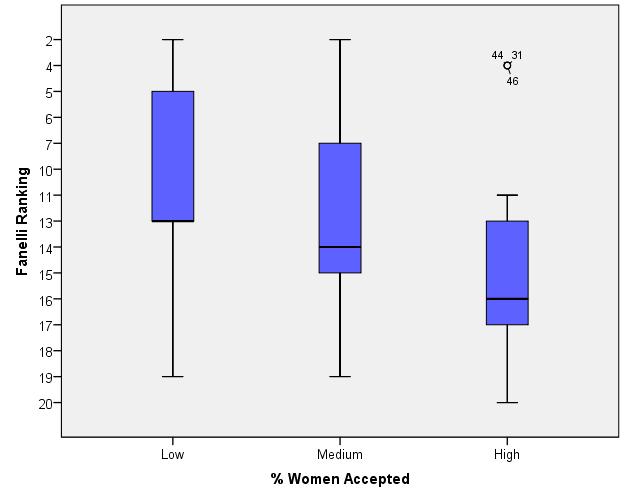
The x-axis of this boxplot shows the percentage of female students accepted onto 73 higher education science courses in the UK in 2011 (latest available data, from the official UK source, UCAS).
The y-axis shows how the course subjects rank on an index of scientific rigour (Fanelli, 2011), with ‘harder’ sciences like physics having a higher ranking (nearer 1) and ‘softer’ sciences like psychology a lower ranking (the lowest being 20).
The boxes show where most of the courses cluster, and the top-and-tailing lines show how widely the data are spread.
(I’ll say more below about those three little outlying numbers in the top right-hand corner: they don’t fit the pattern. For more detail on the making of this graph, see this background information PDF, Fanelli_background.)
The graph seems to suggest that tougher courses have fewer women students, while softer sciences attract more girls.
This is not a new idea. In 2005, the President of Harvard University caused a ruckus by suggesting that ‘one reason there are relatively few women in top positions in science may be “issues of intrinsic aptitude”’. (The quote is from Inside Higher Ed; the link to the transcript of Larry Summers’ speech is, alas, broken).
So, the UCAS data support this controversial claim, yes?
No.
Here are some reasons why not. Continue Reading As science gets tough, the girls get going … to some other career?…
Into the brave new world … of video
January 14, 2013 at 2:54 pm | Posted in Uncategorized | 7 CommentsTags: brain research, introductory guide, neuroanatomy, neuroscience, YouTube
Today I’m trying a new experiment. New for me, at least, and scary, though no doubt many of you will be past masters at it. I’m posting a video on YouTube. It’s the first of a planned series of short, simple talks about neuroscience, and it’s an introductory guide to what’s where in human brains.
My hope is that it will be useful to students starting out, and to others interested in learning more about brains and the methods used to study them. If you’d like to look a little beyond the headlines and pretty pictures of fMRI, for instance, there’ll be a talk on that coming soon.
I’ve tried to keep the talks short, clear, and as fluent as possible, although, as I soon found out, it’s extremely difficult to talk coherently for minutes at a time about any subject, even one you know well.
Finally, the biggest disadvantage to this project, from my point of view, is that it’s video. My childish sympathy for the old idea that photographing someone stole their soul has been overlaid in adulthood by a properly scientific doubt as to whether people have souls – but I retain the child’s dislike of being imaged. However, communication works better when you can see the communicator. And this is such an important topic to communicate. So here goes.
Why Good Writing Matters
January 9, 2013 at 10:56 am | Posted in Uncategorized | 120 CommentsTags: language, neuroscience, science, science writing, skills

Years ago now, I recall a senior scientist who’d read a piece of my work saying doubtfully, ‘It’s very well-written. Very literary.’ The implication was clear: ‘But is it good science?’
With hindsight, I can agree: that particular effort wasn’t ace. I can’t even remember its title, and the obscurity’s well-deserved. What did stick was my surprise that my colleague (undoubtedly a good scientist) saw good science and good writing as not just independent, but even perhaps opposed, since science is all about precision and language is irretrievably vague.
Years later, I still have a problem with this. Continue Reading Why Good Writing Matters…
Academic careers: survival of the fittest?
December 10, 2012 at 3:43 pm | Posted in Uncategorized | 1 CommentTags: Academia, academics, Disability, Disabled, HESA, Higher Education Statistics Agency, science, science careers

And yes, I do mean physically fit, not fit as in RateMyProfessors’ hotness scale.
For a profession which involves so much sitting in meetings and staring at computer screens, academics are an amazingly fit and healthy bunch. I have figures from the UK which make the case. Take a look. Continue Reading Academic careers: survival of the fittest?…
Dropping out of a science career, in a picture
December 10, 2012 at 12:19 pm | Posted in Uncategorized | Leave a commentTags: Academia, academic careers, postdoc, postdoctoral researchers, professors, Science and technology, Women in science

Continue Reading Dropping out of a science career, in a picture…
Copyright notice
December 10, 2012 at 12:15 pm | Posted in Uncategorized | Comments Off on Copyright noticeTags: Copyright, Fair use, Intellectual property, Kathleen Taylor
Please note that all material on this site is copyright Kathleen Taylor 2014. Feel free to copy any of it, only please state clearly where it came from by including a link to http://www.neurotaylor.com. Thanks.

neurotaylor
-

Blog at WordPress.com.
Entries and comments feeds.
 neurotaylor
You must be logged in to post a comment.